The Najida is not a «green or eco» sailing boat as a matter of fashion.
This is a boat conceived, maintained, and used for years with a simple approach: sailing for a long time, comfortably, while limiting the impact on the sea and the places visited.
The sailboat Najida is designed for sailing in a more environmentally friendly way, without sacrificing onboard comfort or autonomy.
The technical features it is equipped with aim to reduce consumption, limit impact and promote more efficient navigation, while still allowing for a comfortable lifestyle on board for several days.
Here, eco-responsibility isn't just marketing speak, but a concrete approach, lived day-to-day on board.
My philosophy as a skipper it is unambiguous: you love Greece for its wild coves, its unspoiled spaces, its crystal-clear waters.
You'd like your children to one day be able to show their own children what you are showing them today.
Chat directly with Jean-Michel, owner-skipper of Najida
WhatsApp: +336 17 34 75 27 E-mail: jm@najida.com
The energy on a sailing boat or catamaran rental in Greece at Athens, in the Saronic Gulf, from Euboea, les Cyclades And Elsewhere…
It is essential for navigation – instruments, electronics, regulation lights – but also for life on board: lighting, 220V, refrigerators, freezer, pumps, watermaker...
The energy on board a charter sailing yacht with five cabins (up to 12 people) is a central topic, in Greece as elsewhere at sea.
On board, we are not at home.
In the wild Greek anchorages, there are obviously no electrical outlets, and the available power is never infinite. Therefore, one must be even more mindful of how it is consumed.
However, paying attention is not enough.
However, this energy still needs to be produced, stored efficiently in batteries, and then used intelligently, without compromising on safety or comfort.
Batteries: real-world battery life and reduced impact
On the majority of charter sailboats and catamarans, in Greece as elsewhere, the batteries are almost always lead-acid batteries.
They are inexpensive to buy, but highly polluting during manufacture and recycling. Their capacity remains limited: with four or five 100-amp 12-volt batteries, the autonomy rarely exceeds one or two nights.
The sailing boat Najida is not equipped in this way.
The entire electrical network has been redesigned and increased from 12 to 24 volts, which significantly reduces losses and consumption on the most energy-intensive equipment.
On a cruise, comfort must not come at the expense of range.
Najida is equipped with lithium batteries, which are lighter, more compact, and offer a much higher capacity for equivalent weight and volume. These batteries are also more easily recyclable, following a principle similar to that used for telephone or laptop batteries.
Solar panels: unrestricted autonomy
Few charter.
In areas that are very popular with tourists, even with major rental companies, generator sets are often preferred, which are noisy and highly diesel-consuming.
On board the Najida, to be careful does not mean to restrain yourself.
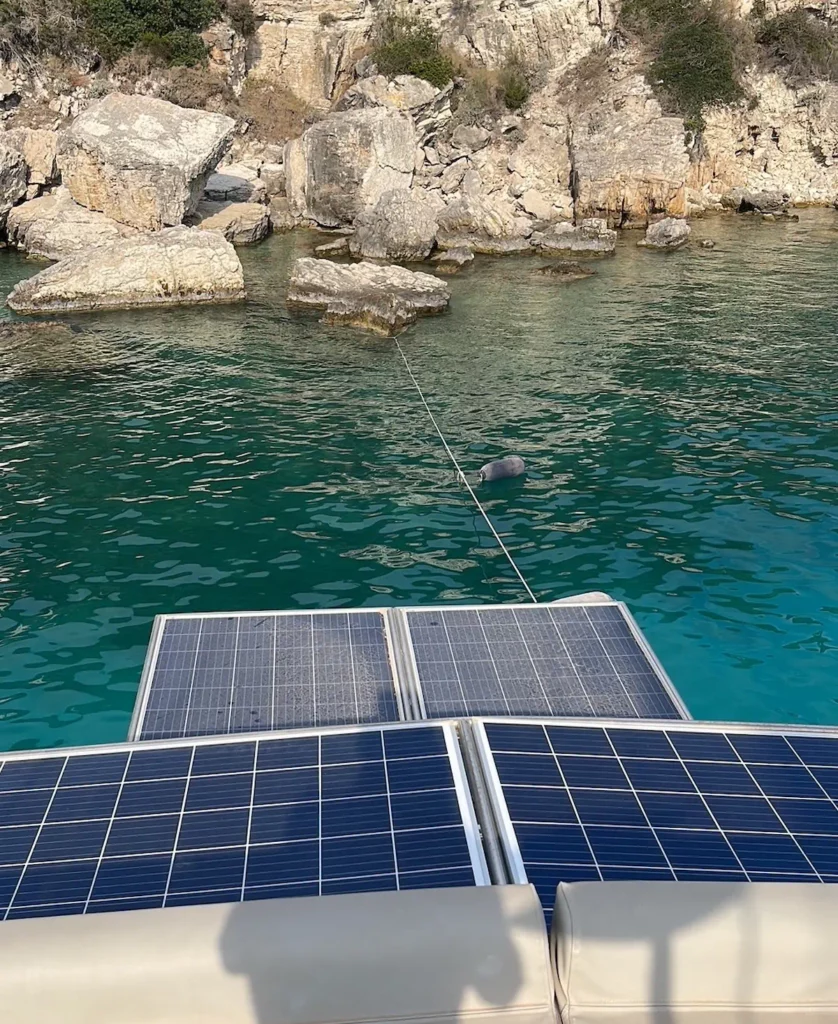
A cruise doesn't have to mean compromising on comfort. To this end, the sailing yacht is equipped with nearly ten square metres of 24-volt solar panels, representing a power output of approximately 2,000 watts.
This setup allows batteries to be recharged autonomously, thanks to renewable, silent, and constantly available energy, whilst maintaining genuine comfort of living on board.
Cold on board during cruises
Storing food aboard a sailboat is always more complex than on land.
Refrigerators are smaller, they are used constantly, and a cruise often involves several people on board, sometimes two families, with repeated openings throughout the day.
Refrigerators
On board the Najida, three refrigerators ensure food comfort without over-consuming energy.
Two of them work on a common compressor: the larger one drives the smaller one, which optimises operating cycles and limits power consumption.
The compressor is cooled by seawater, which avoids the use of a fan, which is always energy-hungry.
As a latest-generation model, it uses around 30 % less electricity than older models.
The third refrigerator, mainly used for drinks, functions differently.
It is powered by 220 volts and only operates for two hours a day, exclusively thanks to the energy produced by solar panels. It uses a positive cold eutectic plate system: the plate cools down during the operating phase, then releases cold for a period of up to 24 hours, with minimal consumption.
The freezer

Aside from large vessels, yachts, or catamarans equipped with generators, it is very rare to find a freezer on board a charter sailboat. The reasons are simple: lack of space and energy consumption.
The Najida's galley, particularly spacious for a cruising monohull, allowed me to incorporate a freezer without compromising on space.
As with refrigerators, the cooling unit is of the latest generation and cooled by seawater.
A welcome comfort on board... and sometimes for our neighbouring boats too, when it comes to ’borrowing« a few ice cubes.
Fresh water on board, autonomy and freedom
Freshwater is a vast topic when cruising.
On the majority of charter sailboats, during a week of sailing, stops in ports are rare – and for good reason: people don't come sailing in Greece to visit the quays. However, these boats most often have limited tanks, rarely more than 500 to 600 litres of fresh water.
On board the Najida, the capacity reaches 1,750 litres of fresh water, which radically changes life on board.
This reserve enables genuine autonomy to be maintained, even with several people on board, without turning the cruise into a permanent exercise in restriction.
On many charter boats, as soon as two families are sharing the vessel, compromises quickly arise: shorter showers, avoiding rinsing after a swim, constant vigilance over every litre consumed.
The classic solution then is to opt for large units, yachts or catamarans equipped with a generator and a continuously operating watermaker.

On board the Najida, the approach is different.
A generator set is present, but it is not used to power the desalination unit, except in rare specific situations. The aim remains to prioritise autonomy, efficiency, and reasoned use of resources, without sacrificing the comfort of real onboard living.
The desalinator: producing water without being reliant on the generator
Le Najida is equipped with two desalinators producing 90 and 150 litres of fresh water per hour respectively.
As with most sailing boats, these appliances operate on 220 volts. This usually means regular use of a generator, which is noisy and a fuel consumer.
On board the Najida, the system has been redesigned to avoid this systematic reliance on the generator, while still maintaining sufficient water production for real life on board.
Optimise operation at 220 volts
The first axis consisted of improving the entire 220-volt electrical system.
The Najida converter, which transforms 24-volt direct current into 220-volt alternating current, has been reinforced to absorb the consumption of the desalination units.
The cables connecting the production sources to the equipment have also been replaced, in order to limit losses and to allow for a higher current flow.
Concretely, when the engine is running — usually one to two hours per day for travel — the engine's alternator, combined with the solar panel production, powers the watermaker.
Over 200 litres of fresh water can thus be produced daily, in addition to the 1,750 litres taken on board at the start.
Result: end of limited showers, sea water rinses and uncomfortable compromises.
A 24-volt alternative power supply
The second axis was more complex to implement.
It consisted of creating a second circuit to directly power the desalination unit's membrane at 24 volts.
This configuration requires a second lift pump, a specific 24-volt motor, and a new dedicated high-pressure pump.
After numerous trials and adjustments, this system now works reliably and effectively.
Combined with the significant battery bank and the considerable surface area of solar panels, this solution enables autonomous, quiet freshwater production suitable for comfortable cruising over several days.

Drinking water on a cruise: reducing plastic on board

On a cruise, and even more so in Greece during the summer period, drinking water consumption is generally estimated at about one bottle per day per person.
The calculation is simple: ten people on board for a week represent nearly 70 bottles of water, which is about a dozen packs to transport, store, and then discard.
A comfortable habit, but one whose environmental impact is far from negligible.
To concretely address this issue, the Najida is equipped with a reverse osmosis filtration system.
An installation still very rare on board charter sailboats in Greece, and yet particularly well-suited to life at sea.
How does a reverse osmosis filter work
The water from the reservoirs is first filtered progressively, through several increasingly fine filtration stages.
It is then put under pressure and passes through a reverse osmosis membrane, on a principle similar to that of a desalination unit.
The water obtained is potable, free from micro-organisms, bacteria and impurities.
A dedicated tap, installed directly at the sink, makes it easy to fill glass bottles or reusable water bottles.
This system significantly reduces the use of plastic bottles on board, while guaranteeing quality drinking water, available at any time during the cruise.
Waste management: common sense and organisation
During a sailing cruise, waste volumes increase rapidly after a few days, especially when several people are sharing life on board.
Even when being careful during refuelling, the issue of rubbish quickly becomes central.
On board the Najida, waste management is based on a simple and rigorous organisation, structured around three distinct streams.
Organic waste
The first bin is for organic waste.
These are never discharged into the sea when moored. In accordance with regulations, they are only disposed of offshore, more than three miles from the coast, after being reduced to small pieces when necessary.
Non-recyclable waste
The second bin is for waste that cannot be disposed of at sea or recycled during the cruise.
This mainly concerns metal or similar packaging, kept on board until disposal ashore.
Recycling
The third bin, located outside the kitchen, is for recycling: plastics, glass, and light packaging.
These waste materials are systematically rinsed to limit odours and facilitate their subsequent sorting.
A word on toilets
Nothing is discharged into the sea that is not biodegradable.
The toilets are equipped with dedicated bins, and toilet paper is never flushed into the sea.
Another way to navigate
All these technical choices only make sense because they are experienced on a daily basis.
They are not there to display a «green» label, but to enable navigation
simpler, more autonomous and more respectful of the places we pass through.
On board the Najida, this approach concretely changes the cruise.
More time at anchor, fewer constraints, more silence.,
more freedom, and a real quality of life on board.
As the skipper and owner of the boat, I make these choices for myself before sharing them with you.
Because sailing for a long time, in good conditions, is also about taking care of the sea
and places we love to discover – today, and for a long time to come.
This technical and energy independence is integrated into all cruises offered on board the Najida, whether it is a Private family cruise or of a formula shared in June and September.
The detailed terms and conditions can be found on the page prices and availability.
Let's build your next cruise together. jm@najida.com – WhatsApp: +336 17 34 75 27